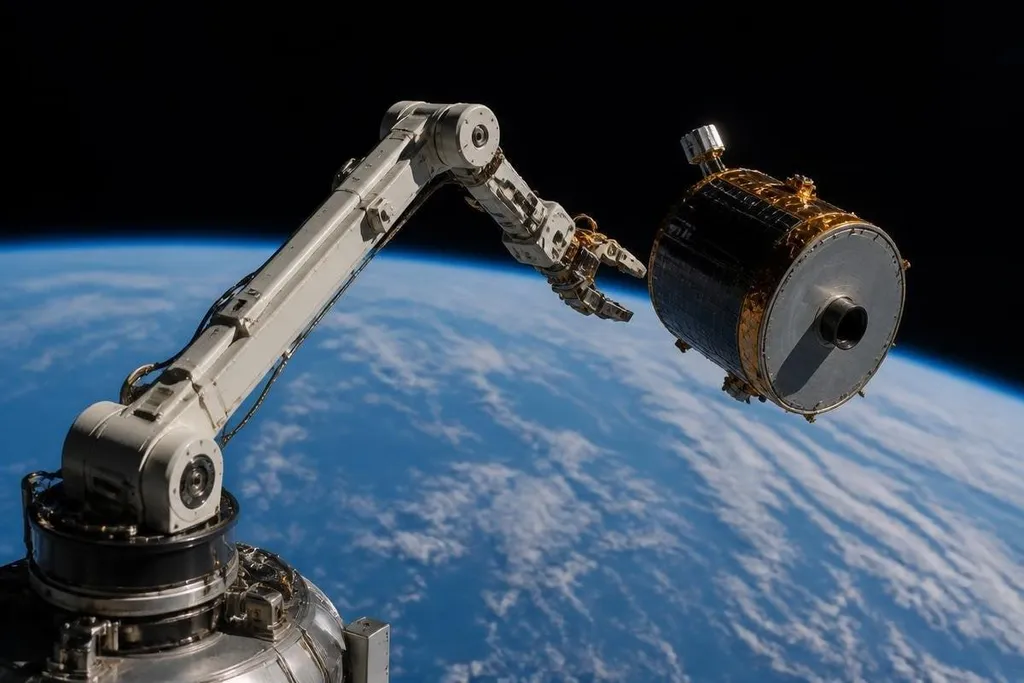
Space junk is hardware left in orbit after a mission ends: dead satellites, spent rocket parts, and fragments from collisions. Removing it calls for machines that can inspect objects, match their motion, and move them without creating more debris.
A ground crew can control a spacecraft, but a robot in orbit must sense its target and act with little room for error. That makes space junk a robotics problem as much as a spaceflight problem.
- Robotic servicing can inspect objects before a removal attempt.
- Capture tools must work with unknown shapes, speeds, and surfaces.
- Any system must prove that its own mission will not add new debris.
Why old hardware is hard to remove
Most abandoned objects were never built for capture. They may have no handle, docking port, or safe place for a tool to touch. A robot may need to hold a damaged panel, a rocket body, or a satellite that is still rotating.
That changes the task from picking up an object to controlling its motion first. A servicing vehicle could use cameras and other sensors to estimate the target’s position, speed, and rotation. It then needs to move at a matching rate before the gripper or capture frame makes contact.
A small error can have a large effect. Contact can push the target away, change its spin, or damage the servicing vehicle. The robot must also keep its own position steady while its arm moves, much as a worker must brace a tool before applying force.
What robots could do
Inspection is the lowest-risk starting point. A robot could fly near an inactive satellite, record its shape, check for damage, and help operators decide if capture is practical. That information would make later work safer because the team would have a current view of the object rather than an old design file.
Capture is harder. Possible tools include robotic arms, nets, docking devices, and gripping systems that hold a part of the target. Each tool fits a different object. A net may cover a large body, while an arm may work better when the target has a reachable structural point.
After capture, the robot must control both vehicles as one system. It may need to stop the target’s rotation, move it to a safer orbit, or guide it toward a planned disposal path.
It also needs enough fuel and power to complete the task after the first contact.
A servicing robot still has to control the target after its grappling tool makes contact. Robot24.com space robotics reporting can tie that moment to named missions, capture tools, and test results before the next section examines the forces and motion that follow.
The hard parts are after contact
A capture video can make the task look finished. It isn't. The robot must hold the object through engine burns, vibration, heat changes, and communication delays. A failed grip at that stage could leave two uncontrolled objects in orbit.
Control software also needs clear limits. If the target spins too quickly, its surface breaks apart, or the robot loses a sensor, the system needs a safe way to stop and move away. A remote operator can guide the work, but software must handle fast motion between commands.
The business case has its own test. A servicing mission needs a paying customer, a legal plan for handling another owner’s hardware, and a target whose removal matters enough to cover the mission cost. Without those pieces, a capable robot may remain a technology exercise.
What remains unproven
Robotic capture has been tested in controlled settings, but each real target brings unknown damage, motion, and ownership rules. A system that works with a prepared satellite may need different tools for an old rocket body with no capture points.
The first missions will also show how much human control remains necessary. More remote control may lower the software burden, but it can increase communication demands and operating cost. More autonomy may reduce delays, but it places greater weight on sensing and fault handling.
I'd fund inspection missions before removal missions. A detailed scan of a target can prevent a costly capture attempt and give later robots better data to use.
A practical buying and mission checklist
Before supporting a robotic space-junk project, check these points:
- Target data: Does the team know the object’s shape, orbit, rotation, and condition?
- Capture plan: Can the tool hold the target without breaking panels or changing its path?
- Abort mode: Can the robot release, retreat, and report a fault after a bad contact?
- Debris control: Does the plan lower the chance of creating fragments during the work?
- End state: Is there a clear orbit or disposal path for the captured object?
- Cost owner: Has a customer or public agency agreed to pay for the mission?
Robots won't remove every piece of space junk. They can make the work repeatable by inspecting targets, controlling contact, and moving selected objects with a clear end state. The next proof is a mission that completes those steps on an unprepared target without leaving a second problem behind.